Motherland Sovereign: Growing Land Food and Nature as Productive Assets

Land can be a shelter, a memory, a farm, a water body, a grove, a lease, a food system, or a burden. The difference lies in how it is governed.
A piece of land does not become productive because someone calls it valuable. It becomes productive when soil, water, labour, access, legality, food output, biodiversity, and cash flow are brought into a patient system. That is the disciplined promise of Motherland Sovereign, a way of seeing land, food, and nature as living productive assets rather than speculative objects.
This approach sits in the Moon archetype, the peacemaker. It does not rush into conflict with nature, community, or law. It observes cycles. It calms greed. It asks one clear question before every land decision: will this grow real productive value without making false claims?
Land + Food + Nature = Productive Assets, Not Speculative Promises.
That golden rule matters in India, where land often carries emotional, cultural, and financial weight at the same time. Families inherit it. Farmers work it. Developers package it. Investors chase it. Climate makes new demands on it. Food systems depend on it. Water stress exposes weak planning. The Motherland way brings the conversation back to proof, stewardship, and measured growth.

Growing land starts with accepting its living nature
Land is often treated as a flat number on a document. Area. Rate per acre. Future appreciation. Nearby road. Distance from a city. These details matter, but they are never the whole picture.
Useful land has a living profile.
It has soil texture, drainage behaviour, slope, access to water, existing vegetation, legal boundaries, neighbouring use, local labour availability, market routes, and a climate pattern. A fertile one-acre plot with water discipline can be more productive than a larger holding that cannot be accessed in the monsoon. A parcel with trees, grazing, farm access, and a verified title can carry more long-term strength than land bought only because someone said prices may rise.
The Motherland view begins with resource development, not price excitement. It asks how land can support food, dwelling, water, nature, and stable income over time.
That may include:
Seasonal vegetable cultivation
Fruit orchards suited to local climate
Agroforestry with timber, fodder, and shade trees
Seed production or nursery activity
Farm stays where allowed by law
Composting and soil improvement
Water harvesting structures
Natural fencing and biodiversity corridors
Long-term lease models for verified farm operations
Low-impact dwellings that support land care
None of these should be promised casually. Each depends on site conditions, permissions, capital, operating skill, market access, and time. A coconut holding in coastal Karnataka, a pomegranate orchard in Maharashtra, a millet farm in Rajasthan, and a vegetable cluster near Bengaluru all carry different economics and risks.
The first act of sovereignty is to stop copying models blindly.
A Motherland Agri Dwelling And Nature Sovereign system does not ask land to perform against its nature. It studies what the land can carry, what it can restore, and what it can produce without being exhausted. That is why peace is central to the archetype. Productive land is not forced into output. It is guided into rhythm.
Productive asset growth is the main measure
The primary key performance indicator is simple: productive asset growth.
This is wider than profit, but stricter than sentiment. It asks whether the asset is becoming more capable, more useful, and more resilient with time.
A land project may look successful on paper because nearby rates have increased. That does not mean the land itself has improved. If soil has degraded, water has dropped, boundaries remain disputed, access is weak, and no productive activity exists, the asset may still be fragile.
By contrast, land may become more valuable in a grounded way when it gains:
Healthier soil with better organic matter
Reliable water harvesting or recharge
Productive trees and perennial crops
Clear fencing and access paths
Verified records and transparent boundaries
Working cultivation plans
Local buyers or farm gate channels
Ecological buffers such as tree belts and ponds
Skill systems for labour and maintenance
These improvements create asset depth. They can support revenue, reduce risk, improve usability, and make the land easier to manage across seasons.
The supporting KPIs give the concept structure.
KPI | What it shows | Why it matters |
Revenue per acre | Productive financial output from land use | Helps compare crops, leases, and activity models with care |
Land projects | Physical development completed on the site | Shows whether plans are becoming real assets |
Food production | Quantity and quality of produce | Connects land to nourishment and market relevance |
Water | Availability, storage, recharge, and use discipline | Protects the land from seasonal stress |
Nature | Trees, soil life, pollinators, and biodiversity | Builds long-term resilience and ecological value |
Revenue per acre is useful, but it must be handled honestly. It changes with crop, region, weather, input cost, market price, labour, and management quality. No responsible land system should claim guaranteed income without verified operating data.
The better question is not “How much can this land make?” The better question is “What can this specific land produce under a lawful, skilled, funded, and season-aware plan?”
That question protects everyone involved. It respects the farmer, the investor, the buyer, the landowner, and the land itself.

Food turns land into a working system
Food production brings discipline to land decisions. It forces a project to face soil, water, seasons, pests, handling, storage, transport, labour, and buyers.
Speculation can survive on stories. Food cannot.
A farm must answer practical questions every week. What is being planted? Who is maintaining it? How much water will it need? What happens if the rains arrive late? Where will the produce go? Who records input costs? Which crops restore the soil and which crops draw heavily from it? What is eaten locally, and what depends on distant markets?
Food also creates layered value. A small mixed farm can produce vegetables, fruits, herbs, fodder, compost, seed, and nursery plants. Not all at once. Not without skill. But through planning, land can move away from a single risky bet.
Diversity protects the productive base
A monocrop may suit some regions and commercial models, but it can expose landholders to price swings and crop failure. A more balanced system may include:
Short-cycle crops for regular movement
Perennial trees for long-term value
Fodder patches for livestock-linked systems
Native species for shade and pollinators
Kitchen garden zones for household nutrition
Compost areas for soil return
Water bodies for recharge and microclimate support
This does not mean every land parcel must become a complex farm. It means productive design should reduce avoidable dependency.
In many Indian conditions, a land project that combines food and nature can be more stable than one built only around quick resale. The work is slower. The claims are quieter. The base is stronger.
Food needs market truth
Growing food is only half the task. Selling, storing, processing, or consuming it completes the cycle.
A productive land plan should look at nearby mandis, local retailers, community-supported buying, hotels, processors, weekly markets, and direct household demand. It should also understand the limits of each channel. Direct selling can improve margins, but it demands sorting, packing, transport, communication, and trust. Wholesale selling may be faster, but prices can move sharply.
No channel is magic. Every channel has cost.
A sovereign food plan records these details before scaling. It tests crops on a small area. It tracks input cost, labour time, yield, wastage, and sale price. It changes based on evidence, not pride.
This is where the Peacemaker identity becomes practical. It avoids drama between ambition and reality. It lets the land speak through results.
Water is the quiet ruler of land value
Water decides the carrying capacity of land. It shapes crop choice, housing capacity, tree survival, livestock feasibility, and long-term resilience.
In India, water can change sharply across districts, villages, and even neighbouring plots. One site may hold rainwater well. Another may drain too fast. A third may suffer from waterlogging. Borewell depth, canal access, rainfall pattern, soil type, tanks, open wells, and groundwater rules all shape the decision.
No land plan should make easy water claims. A seller may say water is available. A neighbour may believe an old source is reliable. A borewell may work one year and fail in another. Verification matters.
Water stewardship includes:
Mapping natural slope and drainage
Protecting existing ponds, tanks, and water paths
Harvesting rainwater where suitable
Recharging groundwater through lawful structures
Using mulching and shade to reduce evaporation
Choosing crops that match local water reality
Avoiding wasteful irrigation habits
Treating greywater carefully where permitted
Keeping chemical use away from water bodies
A productive asset grows stronger when it uses water with restraint. This is especially true for farms that aim to combine dwelling and cultivation. Human use, garden use, crop use, and ecological use must be planned together.

Water creates value when it is documented
Water improvement should not remain a verbal claim. It should be measured and recorded.
A land project can maintain simple records:
Rainfall notes by month
Water source performance by season
Irrigation schedule
Pond or tank condition
Crop water needs
Mulching coverage
Signs of erosion or waterlogging
Repairs to bunds, channels, and pipes
Such records build institutional memory. If the land changes hands or a new manager arrives, knowledge does not disappear.
This is resource development in its truest form. Not decoration. Not hype. Slow improvement backed by record keeping.
Nature is not a side feature
Many land projects place nature at the edge of the plan. A few trees near the boundary. A decorative lawn. A photo-friendly patch. That misses the real value of ecological design.
Nature helps land function.
Tree cover can reduce heat stress, hold soil, create habitat, provide fruit, offer fodder, attract pollinators, and improve the experience of living on the land. Native grasses can protect open soil. Hedges can soften wind. Ponds can support birds and beneficial insects. Composting can return nutrients. Mixed planting can reduce extreme dependency on purchased inputs.
This does not mean abandoning commercial discipline. It means recognising that a damaged ecosystem increases operating cost.
A nature-positive land plan may include:
Native trees along boundaries
Fruit trees suited to local climate
Pollinator strips with flowering plants
Soil cover instead of bare exposed land
Compost pits or aerobic composting areas
Reduced chemical load where possible
Protection of existing old trees
Living fences where suitable
Bird perches and habitat zones
Seasonal grazing plans where relevant
The goal is not wilderness everywhere. The goal is a productive relationship between land use and natural systems.
Dwelling should serve the land, not dominate it
The phrase “agri dwelling” can be misunderstood. It should not become a way to hide speculative plotting under a green label. Dwelling on agricultural or rural land must follow applicable laws, zoning rules, land use permissions, and local regulations.
A land-based dwelling has a better purpose when it supports stewardship.
It can house caretakers, seasonal workers, farm managers, or families who actively maintain the land. It can support storage, seed work, tool care, produce sorting, nursery activity, and learning. Built space should be modest, climate-sensitive, and placed after understanding drainage, soil, access, shade, and farm movement.
When building dominates the plan, the land often becomes a backdrop. When building serves the land, the whole asset becomes more coherent.
That is the difference between a rural image and a productive rural system.
The legal and ethical boundary must stay firm
The core boundary is clear: no unverified land claims or unrealistic income promises.
This is not a small caution. It is the foundation.
Land carries legal, social, and financial risk. Titles may be unclear. Access roads may be disputed. Agricultural land purchase rules may differ by state. Conversion permissions may be required. Tenancy, inheritance, encumbrance, and use restrictions can affect the project. Forest, coastal, tribal, wetland, and water body rules may apply in certain areas.
This post is informational only and should not be treated as legal or financial advice. Professional due diligence is essential before any land purchase, lease, development, or income projection.
A responsible land process checks:
Title history and ownership records
Encumbrance status
Survey numbers and boundaries
Physical access and right of way
Zoning and land use permissions
Agricultural land purchase eligibility
Water source legality
Existing leases or tenancy claims
Soil and site conditions
Local community context
Tax and registration requirements
Environmental restrictions where relevant
The ethical boundary also includes communication. A land project should not use language that promises fixed returns from farming unless supported by a lawful contract, verified operations, and clear risk disclosure. It should not claim water certainty without evidence. It should not suggest future conversion or development as a guaranteed outcome. It should not sell “nature” while removing the very systems that create ecological value.
Trust grows when claims stay within proof.
A practical operating model for productive land
A productive asset needs a working rhythm. Vision alone cannot manage crops, water, soil, records, and people.
The operating model can be simple, but it must be consistent.
Start with a land diagnosis
Before any major spend, the site needs a ground-level study. This includes walking the land across sections, checking soil, observing plants, speaking with local cultivators, identifying water movement, reviewing legal documents, and understanding access.
A diagnosis should answer:
What is already strong here?
What is weak or risky?
What should be protected immediately?
What can produce within one season?
What may take three to five years?
What should not be attempted on this land?
The last question is often the most valuable. Good land governance includes refusal.
Build in modules
The Motherland system is modular. That means each part should stand on its own while supporting the larger whole.
A site may develop in phases:
Phase | Focus | Example outcome |
Ground phase | Protection and verification | Boundaries, access, records, water mapping |
Soil phase | Fertility and preparation | Composting, soil cover, test plots |
Food phase | Productive cultivation | Seasonal crops, orchard blocks, nursery beds |
Water phase | Storage and discipline | Pond repair, recharge, irrigation planning |
Nature phase | Ecological strength | Tree belts, pollinator zones, native planting |
Dwelling phase | Stewardship support | Lawful shelter, storage, caretaker facilities |
This staged method reduces waste. It also helps reveal whether the project has the management strength to grow.
Record the land like an enterprise
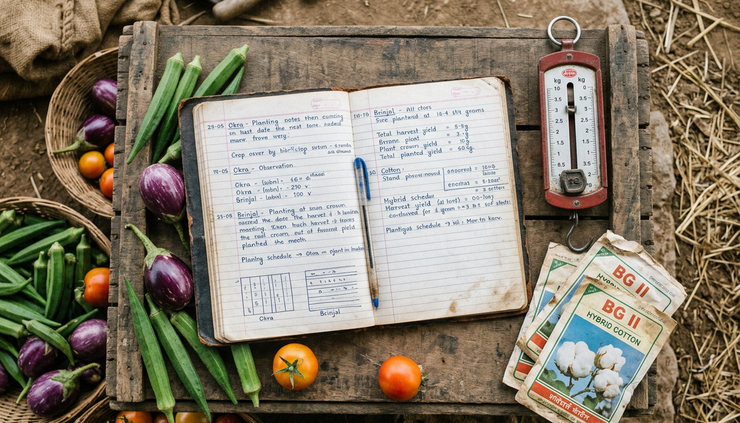
Even a small farm benefits from records. Without records, memory becomes the operating system. That fails when seasons change or people move.
Good records include:
Crop calendar
Input purchases
Labour days
Yield by crop
Sales by channel
Water use notes
Pest and disease observations
Soil improvement work
Tree survival rate
Maintenance costs
Photos from fixed points
Legal and compliance documents
These records protect the project from exaggeration. They also make learning visible.
If revenue per acre improves, the records show why. If it falls, the records help identify whether the issue was weather, crop choice, labour, price, water, or execution.
Respect local knowledge
Land is never managed from a spreadsheet alone. Local farmers, nursery workers, water technicians, soil experts, panchayat-level knowledge holders, and experienced caretakers often know details that outsiders miss.
A sovereign approach listens without romanticising. It respects local knowledge, then tests it through observation and records. This balance prevents two common mistakes: ignoring grounded wisdom, and accepting every local claim without verification.
Peaceful land development is not passive. It is attentive.
The real promise is resilience with proof
The strongest land assets do not depend on one story. They hold multiple forms of value.
They can feed people. They can restore soil. They can hold water. They can host trees. They can support livelihoods. They can provide lawful dwelling. They can teach patience. They can create revenue where the operating model is sound. They can become intergenerational assets when records, rights, and responsibilities are clear.
Their value is not only resale. Their value is productive capacity.
This is a calmer, more demanding way to think about agri, food, and real estate. It does not reject appreciation, but it refuses to make appreciation the only measure. It does not reject income, but it refuses to promise income without proof. It does not reject development, but it asks development to serve land, water, food, and nature.
That is the Peacemaker’s role. To bring settlement between human ambition and living systems.
A Motherland Sovereign project grows best when every claim can be walked, measured, harvested, recorded, or legally verified. If the soil is improving, the trees are surviving, the water is better managed, the food system is active, the records are clean, and the legal position is clear, the asset is growing in a meaningful way.
Land should not be reduced to a rumour of future price. Food should not be treated as a decorative proof point. Nature should not be used as a sales word while being pushed aside.
The better path is slower and stronger: develop resources, measure productive asset growth, honour water, grow food honestly, protect nature, and speak only what can be verified. That is how land becomes more than an acquisition. It becomes a living asset with roots, yield, memory, and responsibility.


Comments